Sunday, November 15, 2020

Okay for Now by Gary D. Schmidt

https://images-na.ssl-images-amazon.com/images/I/51kENITpj+L._SX334_BO1,204,203,200_.jpg

Schmidt, Gary D. Okay for Now. Boston: Clarion Books, 2011. ISBN 978-0-547-15260-8

Plot

Doug has a lot to deal with. He has his dysfunctional family—an older brother who pummels him, another brother away fighting in Vietnam, a mother whom he dearly loves, and a father who mistreats them all. He has his new house—“The Dump”—in a new, boring town, a new junior high school where most of the teachers are suspicious of him, and a new Saturday job as a grocery delivery boy where his customers react the same way as his teachers. And he has secrets that he’s not quite ready to let readers in on. But as Doug deals with his family, his school, and his job, he begins to find some things that are pretty okay. For one thing, there’s Lil, a smart girl who is in most of his 8th grade classes. Then there’s the library, which is not so bad because it has wonderful pictures of birds by some guy named Audubon and a librarian who shows him how to draw. And then there’s his science teacher who isn’t so bad either and who is all excited about the upcoming NASA mission to land some people on the moon for the first time. So maybe things will better than Okay for Now.

Analysis

Doug, an 8th grader in the late 1960s, has many difficulties that kids today still face. He has family troubles, he is faced with suspicion because of his trouble-causing older brother, and he is the new kid at his junior high school. He struggles with being accepted by the adults who think poorly of him and the kids who think the same way. He is initially resistant to learning how to draw (after all, he’s not a “chump”), and there’s other things he doesn’t want to admit to. But there are bright spots in his life that readers will relate to as well—an ice-cold Coke guzzled down on a hot summer day, a new friend whose eyes make you feel warm inside, the joy of learning and improving at a new hobby, and the recognition of others who learn that there’s more to you than they first realized. The author was a preteen in the late 1960s, and this story rings true with readers. Details of the 1960s come about gradually and are expertly woven throughout the book to create a sense of the times—there’s major, well-known events, like the Vietnam War and anti-war protests as well as the upcoming Apollo 11 mission, and then there’s small things, like the cost of a coke and the sounds of a typewriter. The language used throughout is also reflective of the times. The story is told in the first-person point of view with a very distinctive style. Doug acts as narrator and directly addresses the reader, freely employing slang and alternately pointing things out and keeping things from the reader. Interestingly, this not only suits the story and the character as Doug makes casual, sarcastic, humorous, and insightful observations, but is similar to the way Jane speaks to the reader in Jane Eyre, a book that Doug has to read for one of his classes.

Other connections are drawn between Audubon’s birds and Doug’s life (images of the birds are included at the beginning of each chapter). Doug sees himself and his friends and family in the birds, and he sees the birds in the world around him. As the story begins, he views the birds with an air of helplessness or tragedy, such as the Artic Tern that seems to be plummeting into the ocean. However, as the story continues and there are more and more positive interactions in his life, Doug’s outlook begins to change and he realizes that the Arctic Tern isn’t plummeting to his destruction, but actually freely choosing where he will fly to next.

Awards and Recognition

Gary D. Schmidt is a best-selling and award-winning author, and Okay for Now was a National Book Award finalist, has received multiple starred reviews, and has been featured on several recommended reading lists.

“This is Schmidt’s best novel yet—darker than The Wednesday Wars and written with more restraint, but with the same expert attention to voice, character and big ideas. By the end of this tale, […] Doug realizes he’s pretty happy in Marysville, where holding hands with the green-eyed girl—and a first kiss—rival whatever might be happening on the moon.”—Kirkus Starred Review

“Readers will miss Doug and his world when they’re done, and will feel richer for having experienced his engaging, tough, and endearing story.”—School Library Journal Starred Review

“The book is exceptionally well written. Schmidt creates characters that will remain with the reader long after the book is done. Doug’s voice is unforgettable, […] he is a character filled with hope that the reader cannot help but root for.”–VOYA

“Reproductions of Audubon plates introduce each chapter in this stealthily powerful, unexpectedly affirming story of discovering and rescuing one’s best self, despite family pressure to do otherwise.”—Booklist Starred Review

Connections

The theme of art and Audubon’s birds is strong throughout this book. Use this as inspiration for learning more about Audubon’s birds and for trying your hand at sketching or painting a bird of your own choosing. A useful resource can be found here: https://www.audubon.org/birds-of-america

Two major historical event take place during this book: the Vietnam War and NASA’s moon-landing missions. This can spark discussions about these two contrasting events, one full of anger and violence, and the other filled with feelings of hope. Also consider reading other books that take place in the ‘60s, such as:

  • Liar and Spy by Rebecca Stead
  • Dead End in Norvelt by Jack Gantos
  • Revolution by Deborah Wiles
  • One Crazy Summer by Rita Williams-Garcia
  • Feathers by Jacqueline Woodson
  • Shooting the Moon by Frances O’Roark Dowell
  • Vietnam: A History of the War by Russell Freedman (nonfiction)
  • The Far Side of the Moon: The Story of Apollo’s Third Man by Alex Irvine (nonfiction)
  • Destination Moon: The Remarkable and Improbable Voyage of Apollo 11 by Richard Maurer (nonfiction)

If you haven’t already, you may enjoy reading the book that precedes this one: The Wednesday Wars by Gary D. Schmidt. The Wednesday Wars was awarded a Newbery Honor and follows the story of Holling Hoodhood, a friend of Doug’s.

*This review was written for a youth literature class through Texas Woman’s University.

Saturday, November 14, 2020

Alchemy and Meggy Swan by Karen Cushman

 Alchemy and Meggy Swann

Cushman, Karen. Alchemy and Meggy Swan. Boston: Clarion Books, 2010. ISBN 978-0-547-23184-6

Plot

Meggy Swan is a smart young girl who has learned to protect herself with her sharp tongue. She has needed to since she was born with legs that didn’t support her to a mother who didn’t either. Her dear grandmother, who loved and looked after Meggy, passed away, and so Meggy was sent to London to be with her father, an alchemist. But her father doesn’t see the use of a girl who can’t walk without sticks. Amidst it all, Meggy overhears of her father’s role in a plot to poison a baron. In this coming-of-age story, Meggy, unwanted by her parents and often mistreated because of her legs, struggles to find her place in 16th century London—a city where streets run with filth, but also a city where beauty and strength can be found.

Analysis

The author, Karen Cushman, provides resources for further reading and describes the significant amount of research that went in to the creation of the book to ensure that the story remained authentic and the details accurate. The colorful, vivid language used throughout the book is true to the times and still reads smoothly. Readers get to explore and experience Elizabethan London right there alongside Meggy as she ventures further beyond her father’s house and workshop. Interesting historical details are interwoven into the story, such as when Meggy empties her chamber pot into the street, witnesses a fire and the attempts to put it out, partakes in her father’s alchemical experiments, and even sees the queen from a distance. Although Meggy was born in 16th century England, readers will be able to relate to her desire to transform herself. Strong-willed Meggy struggles with feelings of frustration and disappointment, with feeling unwanted by her parents, and with feeling held back by her legs and her apparent inability to take care of herself. She also has to deal with insults and jeers from both strangers and neighbors who believe her disability was earned due to past sin or was the work of the devil. Meggy and the people she meets throughout the book all have varying attitudes towards her disability. Although the exact beliefs (that babies born with physical deformities were touched by evil) held by some of the characters in the book may not be held today, people today still have varying reactions toward physical differences. Despite these struggles, Meggy learns that she has other strengths and realizes she can look after herself. She also learns to take pleasure in friends and realizes she can use her strengths to help others.

This novel will appeal to all readers who have felt out of place and wished for different circumstances, different relationships, or different bodies. A clear theme of transformation is present in the book. Meggy’s father attempts to transform metals into gold through the process of alchemy. Meggy dreams of being transformed so that she can walk easily, run, and dance. But through her own hard work, pushing herself out of her comfort zone and connecting with others, Meggy is able to make a place for herself and it is her outlook that is ultimately transformed.

Awards and Recognition

Karen Cushman is an award-winning author, and Alchemy and Meggy Swan has received several starred reviews and has appeared on multiple “best book” lists.

“Meggy is a heroine in mind and deed. Cushman has the uncanny ability to take a time and place so remote and make it live. Readers can hear and see and smell it all as if they are right beside Meggy. She employs the syntax and vocabulary of the period so easily that it is understood as if it’s the most contemporary modern slang. A gem.”—Kirkus Starred Review

“Because so many historical novels set in this period feature girls of royal or noble lineage, it’s bracing to meet Meg, who empties her own chamber pot into the ditch outside her door and trades strings of creative Elizabethan insults with Roger, her best friend. Writing with admirable economy and a lively ability to re-create the past believably, Cushman creates a memorable portrayal of a troubled, rather mulish girl who begins to use her strong will in positive ways.”—Carolyn Phelan, Publishers Weekly Starred Review

“Cushman adds another intrepid, resourceful, courageous girl to her repertoire in this tale set in 16th-century London. […]The astounding sights, sounds, and smells of the city accost [Meggy], and readers see and hear them all through Cushman’s deft descriptive and cinematic prose.”—School Library Journal Starred Review

Connections

This book presents a fascinating look at life in 16th century London. Have a discussion about how your life would be different if you lived then. What would you eat, what would you learn and do, and what would your dreams be? Use other resources, such as those mentioned in the author’s note and the books listed below, to learn more about life in Elizabethan times and support the discussion.

Other books that take place during Elizabethan times, such as:

  • Who was Queen Elizabeth? by June Eding
  • Will Sparrow’s Road by Karen Cushman
  • Isabel: Taking Wing by Annie Dalton
  • All the World's a Stage: A Novel in Five Acts by Gretchen Woelfle
  • The Shakespeare Stealer by Gary Blackwood
  • Who was William Shakespeare? by Celeste Mannis

Broadsides and ballads were an integral element to the plot of the book. Learn more about the printing press and have children write their own ballads and create their own broadsides!

*This review was written for a youth literature class through Texas Woman’s University.

Sunday, November 1, 2020

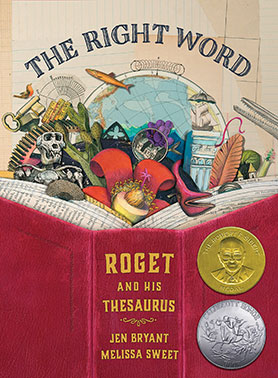
The Right Word: Roget and His Thesaurus

 The Right Word: Roget and His Thesaurus

Bryant, Jen. The Right Word: Roget and His Thesaurus. Illustrated by Melissa Sweet. Grand Rapids: Eerdmans Books for Young Readers, 2014. ISBN 978-0-8028-5385-1

Plot

The Right Word is a picture book biography of Peter Mark Roget, the developer of one of the most prolific reference works: Roget’s Thesaurus. Peter Mark Roget was born in 1779 in England. He began keeping notebooks of words and things that he learned—things that interested—when he was about eight years old. He was a very bright and very reserved boy, and he graduated from medical school at the young age of nineteen. He worked as a tutor before beginning his job as a physician, all the while keeping his notebooks of words. Roget finished his first book of words when he was about twenty-six years old and kept it handy so that he could find the right word when he needed it. He also shared it with his family and continued improving upon it over the years. His first Thesaurus (Greek for “treasure house”) was finally published in 1852, and remains in print today.   

Analysis

This illustrated biography was written as a narrative and cleverly illustrated in the style of a collage, reminiscent of a scrapbook filled with pictures, notebook papers, and other memorabilia. Roget’s lists of words, in English and Latin, are used in the artwork and endpapers. The almost lyrical text tells a charming, true story, briefly addressing but not dwelling on some of the difficulties in Roget’s life (such as the death of his father). The clear focus is Roget as a person, presented as a shy, brilliant man, and the development of his thesaurus. The passage of time throughout the book is marked by major events in his life. The back matter includes a timeline of these major events and more, including some major world events, and a selected bibliography, recommendations for further reading, and additional sources. Readers will thoroughly enjoy this introduction to both the creator and the concept of a treasure house of words.

Awards and Recognitions

The Right Word is a 2015 Caldecott Honor book and a 2015 Sibert Medal Winner. It has appeared on many “best book” lists and has received numerous positive and starred reviews.

“Apt language and ingenious imagery combine to tell the life story of Peter Mark Roget, creator of the thesaurus […] Clever book design and visionary illustration add layers of meaning, as images come together in careful sequence.”—Thom Barthelmess, Starred Horn Book Review

“Bryant’s prose is bright and well-tuned for young readers. […]Injecting her watercolor palette with shots of teal, scarlet and fuchsia, Sweet embeds vintage bits (ledger paper, type drawers, botanical illustrations and more), creating a teeming, contemplative, playfully celebratory opus.”—Starred Kirkus Review

“Lists in wildly expressive handwritten fonts along with cut-paper assemblages stuff the dynamic pages […] with arresting detail. Pivotal moments in Roget’s life get a similar treatment: terms related to plants bloom in tendrils around a watercolor illustration of Roget on one of his many walks. In brilliant pages teeming with enthusiasm for language and learning, Bryant and Sweet joyfully celebrate curiosity, the love of knowledge, and the power of words.”—Sarah Hunter, Starred Booklist Review

Connections

The concepts and illustrations in this book lend themselves well to several crafts and activities. Practice looking words up in a thesaurus and then have children try one of these out:

  • Create a bookmark out of old recycled book pages and record a list of favorite words down the middle.
  • Learn about and try writing a few word association poems, either individually or in a group.
  • Create a collage representing your own life or the life of someone you admire. Make sure to find and use key words!

 Also consider checking out some other illustrated biographies, such as:

  • Mary Anning and Her Remarkable Discoveries, written and illustrated by Don Brown
  • Noah Webster and His Words, written by Jeri Chase Ferris and illustrated by Vincent X. Kirsch
  • Digging For Words: José Alberto Gutiérrez and the Library He Built, written by Angela Burke Kunkel and illustrated by Paola Escobar
  • Beatrix Potter, Scientist, written by Lindsay H. Metcalf and illustrated by Junyi Wu
  • On Wings of Words: The Extraordinary Life of Emily Dickinson, written by Jennifer Berne and illustrated by Becca Stadtlander

*This review was written for a youth literature class through Texas Woman’s University.